
ADA-Compliant Hotel Bathroom Vanities: 2026 FF&E Procurement & Design Guide
An ADA-compliant hotel vanity is not a different style of vanity—it is a standard vanity that satisfies five measurable rules at once: a counter no higher than 34 inches above the finished floor, at least 27 inches of knee clearance at the front edge, hot-water and drain pipes that are insulated or otherwise protected from contact, a 30" × 48" clear floor space for a forward approach, and a faucet a guest can operate with one hand and ≤5 pounds of force. Miss any one and the unit fails inspection no matter how good it looks. This guide turns the 2010 ADA Standards for Accessible Design into a vanity specification that FF&E procurement teams can order against and interior designers can detail without guesswork.
For a U.S. hotel project, accessibility is not optional in the rooms where it scopes. Under the 2010 Standards (§224.2), a property with 1–25 guest rooms must provide at least one mobility-accessible room; the count rises with property size, and accessible rooms are distributed across room types and price points. The bathroom vanity is one of the most frequently failed fixtures in those rooms—usually because the cabinet blocks knee space or the pipes were left exposed. Getting the vanity right early is cheaper than a punch-list rework after the millwork is installed. The technical rules below come from the U.S. Department of Justice standard; for the plain-language interpretation behind each section, the U.S. Access Board is the issuing authority.
The five rules that define an ADA vanity
Most vanity rejections trace back to the same short list. Treat these as pass/fail line items in your spec, not design preferences.
1. Counter height ≤ 34" AFF. The lavatory rim or counter surface may sit no higher than 34 inches above the finished floor (§606.3). On hotel projects this usually means a wall-hung or floating cabinet set lower than a residential 36" vanity—plan the plumbing rough-in accordingly, because moving a drain after the wall is closed is the expensive way to discover the rule.
2. Knee and toe clearance. A clear, open space under the front edge is mandatory: 27" high minimum for a depth of 8", then sloping back, with a toe space 9" high × 6" deep (§306). That open zone is why an ADA vanity cannot have a door, drawer, or full cabinet box where the guest’s knees go.
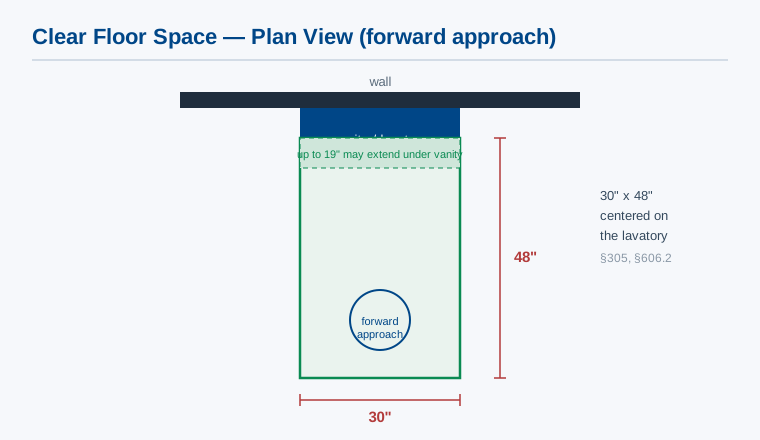
3. Clear floor space. A 30" × 48" clear floor space, centered on the lavatory, must allow a forward approach; it may extend up to 19" under the vanity (§305, §606.2). Coordinate this with the door swing and the accessible route into the bathroom.
4. Pipe protection. Exposed hot-water supply and drain pipes under the lavatory must be insulated or configured so they cannot be contacted (§606.5). A guest using the knee space should never touch a hot or sharp pipe—wrap kits or a removable panel both satisfy this.
5. One-hand, low-force faucet. Controls must be operable with one hand, without tight grasping, pinching, or twisting, at ≤5 lbf (§309.4). Lever handles, wrist blades, or touchless sensor faucets all qualify; cross handles and tight knobs do not.
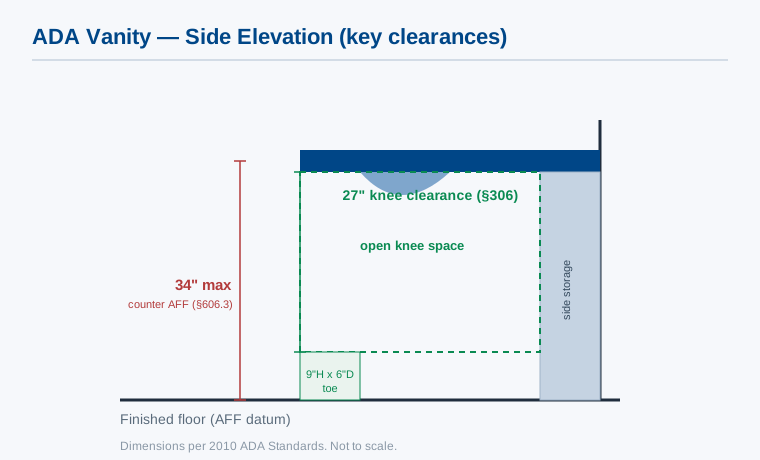
Quick answer: If a hotel vanity has an open knee space, sits at 34" or lower, hides or wraps its pipes, leaves a 30"×48" clear floor area, and uses a lever or touchless faucet, it meets the core ADA vanity requirements. Mirror height and grab-bar coordination are the next two checks.
What the rules mean for the cabinet you actually order
The five rules above translate into a small number of construction decisions on the manufacturing side. For a procurement spec, this is where ambiguity costs money.
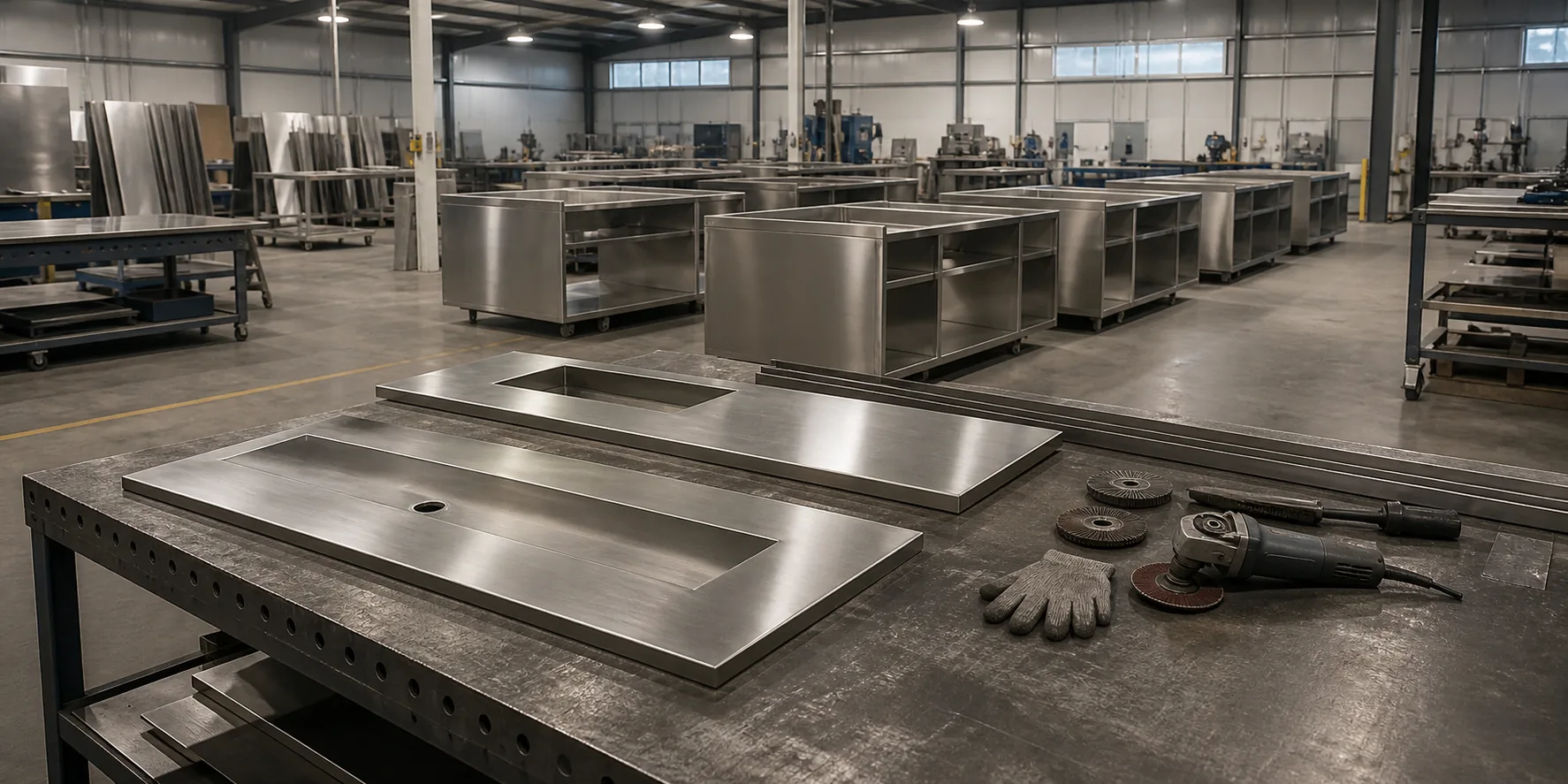
Open-front or wall-hung construction. Because the knee zone must stay clear, ADA hotel vanities are almost always wall-mounted (floating) units or open-front cabinets with the bowl set into a slab top and the storage pushed to the sides. A standard base cabinet with a door under the sink will not pass, so do not let a supplier quote a residential SKU and call it “ADA-ready.”
Material that survives commercial cleaning. Accessible rooms see the same housekeeping chemicals as every other room, plus heavier wheelchair contact at the cabinet sides and toe area. Stainless steel (304 for interior baths, 316 where coastal salt air is a factor) and marine-grade PVC both resist the swelling and edge-delamination that kill particleboard vanities in high-humidity service. The toe and side panels take the most abuse, so edge protection there matters more than on a residential unit; the trade-off between the two stainless grades is laid out in our 304 vs 316 grade guide.
Pre-coordinated pipe protection. The cleanest specs require the manufacturer to supply the vanity with insulation wrap kits or a removable access panel already fitted, rather than leaving it to the plumber on site. This removes the most common field failure from the punch list and means the inspector sees a finished condition, not a promise.
Reinforced wall blocking and grab-bar coordination. A floating ADA vanity transfers load to the wall, and the adjacent grab bars must hold 250 lbf (§609.8). The vanity drawings should call out blocking locations so the framing carpenter and the plumber are working from the same dimensions. When this coordination is missing, the grab bar and the vanity arrive on site competing for the same patch of wall.
Grab bars, blocking, and the wall behind the vanity
The vanity does not stand alone in an accessible bathroom—it shares a wall with grab bars, and the two have to be engineered together. The 2010 Standards require grab bars and their fasteners to resist a 250-pound point load in any direction (§609.8), which a sheet of drywall cannot provide on its own. That load has to land in solid blocking installed before the tile goes up.
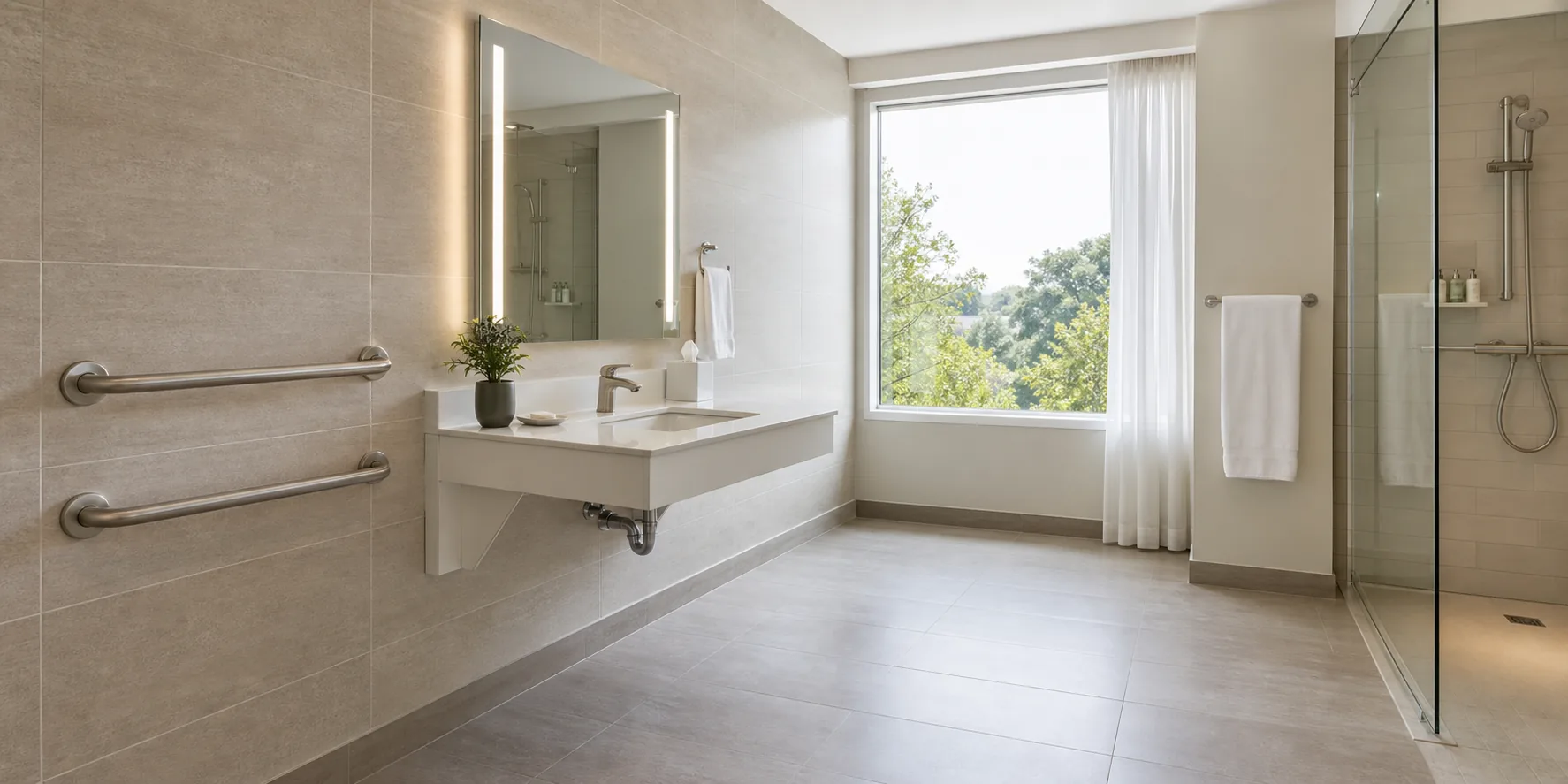
Three coordination points decide whether this goes smoothly. First, the blocking schedule: the vanity shop drawing and the grab-bar layout should appear on the same sheet, with continuous backing where either fastens. Second, the mounting sequence: blocking is framed, then plumbing is roughed in at the lower ADA height, then tile, then the floating vanity and bars are hung and load-tested. Third, the fastener spec: lag into wood blocking or a steel plate, never tile anchors alone. A property that standardizes one blocking detail across its accessible rooms stops re-solving this bathroom by bathroom.
Mirror, lighting, and faucet for accessible rooms
Two finishes above the counter and one at the deck round out the accessible vanity, and each has a number attached. The mirror must place its reflective surface bottom edge at or below 40 inches AFF (§603.3) so a seated guest can use it; the practical move is to run a taller mirror that starts low and rises past the standard-room sightline, so the accessible room does not read differently from the hallway.
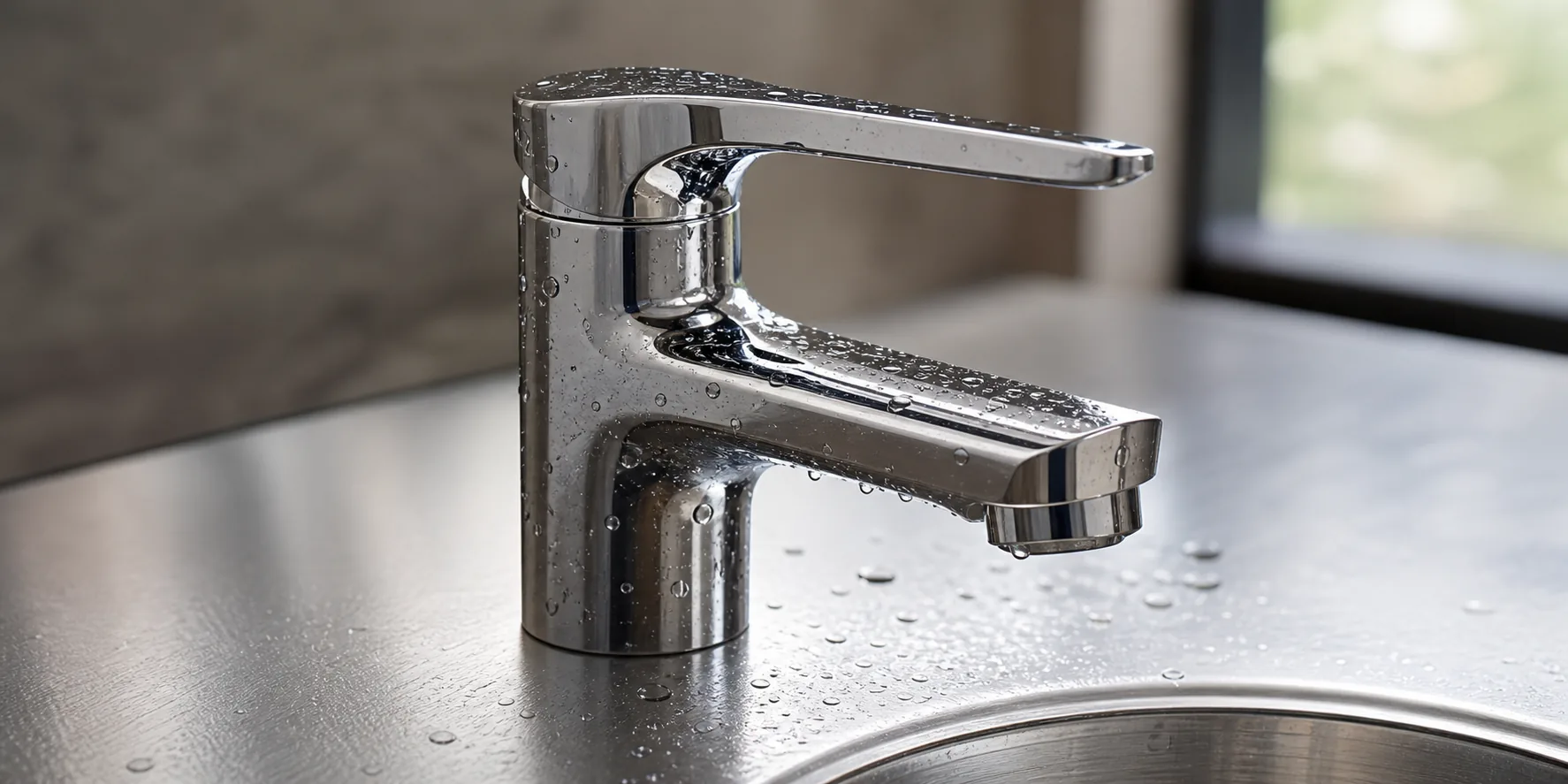
The faucet is the most common late substitution that breaks compliance: a designer swaps in a cross-handle fitting for looks and the room fails §309.4. Lock the lever, wrist-blade, or touchless faucet onto the fixture schedule and treat it as non-negotiable. Lighting is not an ADA dimension, but task light at the mirror still has to render skin tones evenly for every guest; the layered approach that does this is covered in our bathroom lighting guide. Specify the mirror, light, and faucet as one package so the accessible room is detailed once, not assembled from three unrelated decisions.
Two readers, two priorities
ADA vanities pass or fail at the intersection of two roles, and they care about different things.
The FF&E procurement manager is buying to a budget, a delivery date, and a count of accessible rooms. The questions that matter: Does the quoted unit ship with pipe protection included? Is the counter height fixed at 34" or does it need a custom rough-in? What is the MOQ and lead time for the accessible SKU versus the standard one, and does the factory provide an ADA compliance statement referencing the 2010 Standards sections? A vanity that is “ADA-style” but undocumented becomes the buyer’s liability at inspection.
The interior designer is protecting the look while hitting the code. The questions that matter: Can the open-front, lower-height unit carry the same finish family as the standard rooms so the accessible room does not read as “the hospital room”? Where does the mirror sit so its bottom edge stays at or below 40" AFF (§603.3) while still aligning with the standard-room mirror line? How do the grab bars coordinate with the vanity edge without looking like an afterthought? The best accessible rooms are the ones a guest cannot identify as accessible until they need the feature.
When procurement and design agree on the vanity spec before the millwork package is released, the accessible rooms stop being a source of change orders. A custom accessible vanity program that fixes one documented SKU per finish family is what makes that agreement repeatable across a portfolio.
ADA vanity vs. standard hotel vanity at a glance
| Spec line | Standard hotel vanity | ADA-compliant hotel vanity |
|---|---|---|
| Counter height | 36" typical | ≤ 34" AFF |
| Under-sink area | Closed cabinet / drawers | Open knee space, 27" clear |
| Toe clearance | Not required | 9" H × 6" D minimum |
| Floor space | Per layout | 30" × 48" forward approach |
| Pipes | Often exposed | Insulated or protected |
| Faucet | Any | One-hand, ≤5 lbf (lever/touchless) |
| Mirror bottom edge | Per design | ≤ 40" AFF |
Which standard governs: ADA, ICC A117.1, or your state code
Most U.S. hotel projects answer to more than one accessibility document, and the vanity has to satisfy whichever is strictest on a given line. The federal 2010 ADA Standards are civil-rights law and apply nationwide. Separately, most building departments enforce the ICC A117.1 accessibility standard through the adopted building code, and some states (California’s CBC, for example) layer on their own amendments.
For the vanity, the core dimensions—34" counter, 27" knee clearance, 30"×48" clear floor—align closely across these documents, but the safe procurement rule is to spec to the most stringent applicable requirement and have the project’s accessibility consultant confirm which version the local jurisdiction enforces. Writing “meets 2010 ADA Standards and applicable ICC A117.1 / local code” into the purchase order, and requiring the factory’s compliance statement to cite the sections, keeps the responsibility documented rather than assumed.
How many accessible vanities does your project need?
This is the question that drives the purchase order quantity, and it is set by the 2010 Standards scoping table for transient lodging (§224.2), not by the designer’s preference.
The count of mobility-accessible guest rooms scales with the total room count—roughly one accessible room for the first 25 rooms, then a rising number through the brackets, with separate provisions for rooms with roll-in showers once a property passes 50 rooms. Accessible rooms must also be dispersed across room types, classes, and price points, which means your accessible vanity SKU often has to exist in more than one finish family to match different room tiers.
For procurement, the practical takeaway is to confirm the accessible-room count and room-type distribution with the project’s accessibility consultant early, then order the accessible vanity in the finishes those specific rooms require—rather than discovering at install that the accessible room in the suite tier needs a finish you only ordered for standard kings.
Quick answer: Your accessible vanity quantity equals the number of mobility-accessible guest rooms required by ADA §224.2 for your room count, multiplied across the finish families those rooms span. Confirm the count with the accessibility consultant before releasing the FF&E package.
New-build versus renovation: where the vanity decision differs
The same five rules apply on both, but the cost of meeting them lands in different places. In new construction, the accessible vanity is cheapest to get right because the plumbing rough-in, wall blocking, and clear-floor layout are still on paper—set the accessible-room dimensions first and scale the standard rooms from them, and the accessible vanity costs little more than the standard one.
In a renovation, the constraint is the existing rough-in. If the old vanity sat at 36" with enclosed plumbing, lowering the counter to 34" and opening the knee space may require moving the drain and adding blocking—work that happens behind the wall. Here the move that protects the budget is to confirm what can be reused before specifying the unit, and to weigh the accessible upgrade inside the room’s overall return; our hotel renovation ROI analysis frames that total-cost-of-ownership math. Either way, a commercial-grade vanity built for the accessible SKU is the unit that survives the next renovation cycle without becoming the reason for it.
The procurement checklist before you place the order
Use this as the gate between “quoted” and “purchase order.” Every line should have a documented answer from the manufacturer.
- Counter height fixed at 34" AFF (or lower) with matching plumbing rough-in drawings
- 27" knee clearance confirmed on the shop drawing, not just the marketing image
- 9" × 6" toe space detailed at the cabinet base
- Pipe insulation/protection kit included in the quoted price
- Faucet listed as lever or touchless, ≤5 lbf, on the same fixture schedule
- Mirror bottom edge specified at ≤ 40" AFF
- Wall blocking and 250 lbf grab-bar coordination noted on the drawings
- ADA compliance statement citing 2010 Standards sections, signed by the factory
- Accessible SKU lead time and MOQ confirmed against the project schedule
- Finish family matches the standard rooms in the same tier
A vanity that clears all ten lines is one you can install without a follow-up inspection.
From approved spec to a clean install
An accessible vanity becomes real through the same handoff as any hospitality casework, with two checkpoints that matter most for compliance. The shop drawing is where the 34" height, 27" knee clearance, toe space, pipe protection, and grab-bar blocking get fixed as dimensioned commitments—approve nothing that shows the clearances only in a rendering. The first article and mockup room is where those dimensions get verified in a real bathroom with the actual tile, mirror, and lighting, before the full order ships.
Installing one production accessible vanity in a mockup room surfaces the interaction problems no drawing shows: a grab bar that lands a half-inch into the mirror, a clear-floor area the door swing eats into, a pipe wrap that fouls the access panel. Catching those on the mockup costs one unit; catching them after 30 rooms are installed costs a change order and a re-inspection. Send your room dimensions and finish schedule to a factory that returns dimensioned shop drawings, and lock the accessible SKU before the FF&E package releases.
Frequently asked questions
Is a standard 36-inch vanity ever acceptable in an accessible hotel room?
No. The lavatory counter must sit at or below 34 inches above the finished floor (§606.3). A 36" residential-height vanity fails the height rule and usually the knee-clearance rule as well, since standard base cabinets enclose the under-sink area.
Do the pipes really need to be wrapped if the vanity has a panel?
Yes—either approach works, but one is required. The 2010 Standards (§606.5) require exposed hot-water and drain pipes to be insulated or otherwise configured to prevent contact. A removable access panel that conceals the pipes satisfies the rule; so does a foam wrap kit. Leaving bare pipes in the open knee space does not.
Can an ADA vanity still have storage?
Yes. The knee zone in front of the bowl must stay open, but storage can move to the sides of the vanity or to a separate piece of casework. Designers commonly use a slab top with side cabinets so the unit reads as full-size while keeping the required clear knee space.
What grab-bar load does the wall around the vanity need to support?
Grab bars and their mounting must withstand a 250-pound force (§609.8). When the vanity is wall-hung, the shop drawings should coordinate blocking so the vanity load and the grab-bar load are both accounted for in the framing.
Does ADA set a mirror height for accessible bathrooms?
Yes. Where a mirror is provided above a lavatory, the bottom edge of the reflecting surface must be 40 inches maximum above the finished floor (§603.3). A taller mirror that begins low and extends past the standard-room sightline satisfies the rule while keeping the room visually consistent.
Is the ADA Standard the only code my vanity has to meet?
Usually not. The 2010 ADA Standards apply nationwide as civil-rights law, but most jurisdictions also enforce ICC A117.1 through the building code, and some states add amendments. Spec the vanity to the most stringent applicable line and have your accessibility consultant confirm the governing version for the project location.
Should the accessible room use a different vanity finish?
It should use the same finish family as the standard rooms in its tier. ADA requires accessible rooms to be comparable to non-accessible rooms; a matching finish keeps the room from reading as clinical and satisfies the dispersion intent of §224.2.
Spec it once, install it clean
ADA-compliant hotel vanities are won or lost on the shop drawing, not the showroom floor. When the counter height, knee and toe clearance, clear floor space, pipe protection, faucet, mirror line, and grab-bar blocking are all fixed on the drawing before the FF&E package is released—and the factory backs them with an ADA compliance statement—the accessible rooms install on the same schedule as every other room. For hotel groups standardizing across a portfolio, the move that pays off is locking an accessible vanity SKU per finish family up front, so every project draws from a pre-vetted, documented unit instead of re-solving accessibility one bathroom at a time.
Langdeng builds commercial-grade hotel bathroom vanities to dimensioned accessible specifications and backs them with shop drawings and a compliance statement. Send your room dimensions and finish schedule for accessible vanity shop drawings and a dated production plan, or learn more about the factory.
Sources
The references below back the standards and dimensions cited in this guide so a project team can verify each requirement against the issuing body before writing it into a specification.
- 2010 ADA Standards for Accessible Design — U.S. Department of Justice (§224.2 scoping; §305/§306 clearances; §309 operable parts; §603/§606 lavatories and mirrors; §609 grab bars)
- U.S. Access Board — issuing authority and plain-language guidance for the ADA Accessibility Standards
- ICC A117.1 Accessible and Usable Buildings and Facilities — International Code Council, the accessibility standard most building departments enforce through the adopted code