
Foshan Factory Tour Guide: What to Look for in a Vanity Manufacturer in 2026
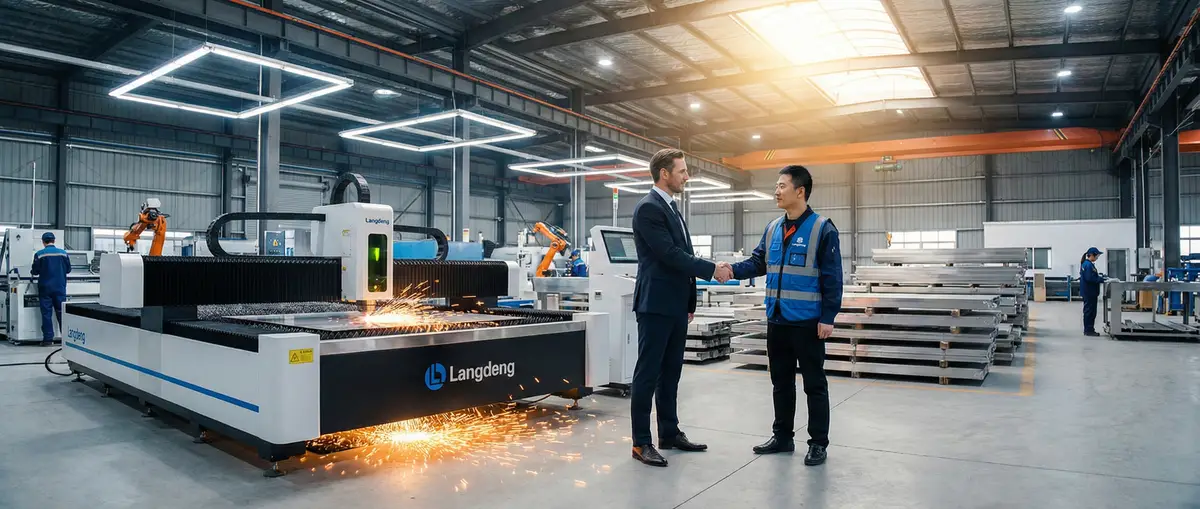
If you are sourcing bathroom furniture from China, all roads eventually lead to Foshan. Known as the "Ceramic Capital" and the global hub for stainless steel fabrication, Foshan is home to thousands of suppliers.
But here is the challenge: Not everyone with a website is a factory. Many are trading companies that mark up prices and lose control over quality. The only way to know for sure is to visit (physically or virtually).
At Langdeng Sanitary Ware, we welcome clients to our production floor every week. Based on 20 years of hosting international buyers, here is your Ultimate Factory Inspection Checklist for 2026. Don't just look at the showroom—look at these 4 critical stations.
Station 1: The Raw Material Warehouse
What to look for: Volume and Labeling.
A real factory invests heavily in raw material stock to hedge against fluctuating steel prices. When you walk into our warehouse, you won't just see a few sheets of metal. You will see tons of 304 Stainless Steel coils and high-grade PVC boards stacked to the ceiling.
The "Magnet Test" Trick: Bring a small magnet. If a supplier claims to use 304 Stainless Steel but the magnet sticks strongly to the raw sheet, it might be cheaper 201 steel or 430 iron. (Note: Some slight magnetism can occur after bending, but raw 304 sheets should be non-magnetic).
Station 2: The Production Line (Machinery vs. Manual)
What to look for: Automation.
In 2026, modern vanity manufacturing relies on precision. Look for these specific machines:
- Laser Cutting Machines: Essential for precise cuts on stainless steel sheets. If you see workers using hand shears, the gaps in your cabinet doors will be inconsistent.
- CNC Bending Machines: These ensure every angle is exactly 90 degrees.
- Automatic Edge Banding (for PVC): Critical for waterproofing. Poor edge banding allows moisture to enter the board, causing swelling.
Station 3: Surface Treatment & Finishing
What to look for: Environment cleanliness and equipment capability.
Surface finishing is where quality differentiates premium from budget manufacturers. Inspect the following:
- PVD Coating Chamber: Physical vapor deposition requires a vacuum chamber and inert gas environment. If a supplier claims to offer PVD but has no visible chamber, they are re-branding electroplating — which has much lower durability.
- Spray Booth for Lacquer: Proper lacquer application requires a dust-controlled, ventilated spray booth. Uncontrolled environments produce orange peel texture, bubbles, or uneven color.
- Edge Banding Machine: For any PVC-wrapped panels, automated edge banding is critical. Poor edge banding allows moisture ingress at the seams, causing delamination within 1–2 years.
- Sintered Stone Bonding: If sintered stone countertops are offered, verify the bonding process. The stone should be mounted with structural adhesive in a controlled press — not just silicone.
Red flags: Dusty finishing environment, workers spray-painting without booths, visible orange-peel texture on sample units, or inconsistent color matching across a batch.
Station 4: Quality Control & Packaging
What to look for: Systematic inspection with documented records.
A factory that takes quality seriously will have a dedicated QC station — not just a final visual check at the shipping dock. Verify the following:
- Salt Spray Test Chamber: ISO 9227-compliant salt spray testing is the industry standard for verifying stainless steel corrosion resistance. Ask to see test reports. A reputable 304 SS factory should have 1,000-hour test certificates.
- Digital Thickness Gauge: Steel thickness directly affects durability. Ask the inspector to measure a sample unit. 16-gauge (1.52mm) is the recommended minimum for cabinet bodies.
- Hardware Function Testing: Soft-close hinges and drawer slides should be rated to 50,000 cycles. Check the hinge brand — well-known brands with clear markings are a positive sign.
- Packaging Materials: Premium vanities should be packed in double-wall corrugated cartons with foam corner protection and internal bracing. Thin single-wall cartons indicate higher transit damage risk.
Documentation to request: Pre-shipment inspection reports, material test certificates (steel grade), and packing list with photo documentation of each unit.
Conclusion: What to Do After Your Factory Visit
A factory visit gives you information that a catalog never can. After your inspection, take the following steps before placing a production order:
- Request 1–2 sample units — evaluate finish quality, hardware function, and packaging in your own warehouse under normal handling conditions.
- Request a material test certificate — verify the steel is SUS 304, with chromium content in the 18–20% range.
- Ask for a reference list — speak to 2–3 existing buyers who have received production orders (not just samples).
- Confirm QC documentation — pre-shipment inspection reports should be a standard deliverable on every production order.
The right manufacturing partner combines technical capability with transparency. A factory confident in its quality welcomes detailed inspections and provides documentation without hesitation.